|
Buildings
in motion
Albeit thin
on the ground, ecological design is beginning to be integrated
into travel buildings, adding another dimension to our understanding
of sustainable transport, and providing a living example of environmental
synergy in action. Here recent examples from Norway and South
West Germany are profiled.
by
Oliver Lowenstein fourthdoor@pavilion.co.uk
- 01273 473501
1900
words + appendix, all rights reserved, 2000
Ian
Jack, columnist and one time editor of The Independent recently
lamented the sad and melancholy task of believing in the UK rail
network as "an effective, reliable and environmentally necessary
mode of transport". Jack's feature piece appeared in the immediate
aftermath of the dual disasters to strike Britain early in November;
a railway network close to collapse, and countrywide flooding
which brought home the lethal consequences of changing weather
patterns, with its knock-on exacerbation of the problems on a
crippled rail system.
What
does this to have do with buildings? Railways have long been heralded
as the most environmental form of medium and long distance transport.
Trains convey hundreds of people while cars can transport only
a handful, (sometimes two handfuls) at the very most. The cumulative
environmental benefits of trains as key to the future of any integrated
transport systems outweighs their costs, and compared to private
automobiles, whether run on non-fossil fuels or not, public transport
is again the most rational long-term environmental choice. And
up until the recent rail calamities the general public had been
cottoning on to railways as an environmental choice. Climate change
may have brought temporary chaos to the railways, but it has underscored
the seriousness of thinking about long term transport networks
which credibly face the challenge of resource and energy efficiencies
required to balance, for instance, carbon emissions. And with
significant investment going into the railways over the next years
there seems at least some hope that the environmental dimension
of railways will move increasingly to the foreground of planning
and strategic thinking. In this context, the built environment
in all its guises, although most visibly the buildings which services
the travelling public, is a part of the equation. Here, it seems
to me, the sustainable architecture, buildings and materials nexus
may find a unique opportunity. By pursuing the integration of
sustainabilty into stations and other building projects, the dual-win
environmental synergy of sustainable travel modes alongside an
environmentally-sensitive infrastructure reinforces the positive
message that environmental thinking, when applied to whole systems,
can be significantly more effective than in isolation. Not only
this but if the psychological attractiveness of transit nodes,
stations, et al. were also integrated as part of a sustainable
appoach, this could have far-reaching effects for the choices
members of the public make when travelling.
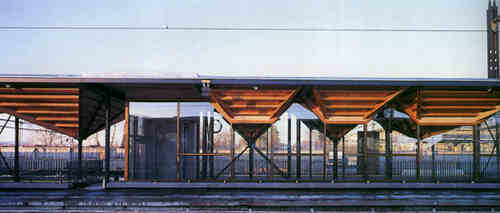
Lillestrom
Station. Picture courtesy of NSB
Stations,
and the other myriad parts of the transport building infrastructure
are not - airports excepted - a particularly glamorous part of
the architectural world. Airports lead the pecking order, bus
stations and even more so the humble bus shelter are at the other
end of the spectrum; ignored by architects and media alike. So
there isn't a prolific range of showcase examples regarding the
modest application of sustainability practice to the transport
infrastructure, in this country. As far as railways are concerned,
in Britain there are the high-profile projects such as Grimshaw's
Waterloo Eurostar extension, but these have been framed within
the vocabulary of hi-ecotech. Europe provides a range of examples,
and although some work originates from the resource efficiency
paradigm of lightweight materials, others demonstrate that there
are projects which fuses the concerns of using natural and local
materials, low energy use, and an aesthetic in sympathy with the
environmentally conscious building movement. Here and there examples
do crop up, this piece instances two contrasting examples. Whilst
these may not be central to the priorities of the current guardians
of the nation's stations and other buildings - Railtrack - It
seems likely the company will become increasingly receptive to
the sustainability dimension of their buildings, a dimension which
may well offer an opening for forward-looking architects and building
and construction companies.
Although
apparently hardly known in Britain, one of the most ambitious
European transport building projects in the nineties has been
the new Gardemoen airport which opened in late 1998, twenty miles
north of Norway's capital, Oslo. As part of this, a new rail link
was built from the city-centre station out to Gardemoen. At the
initial planning stage ten years earlier, sustainability was singled
out as a priority for the later planning, design and tendering
processes. By march 1995 research into suitable materials was
being concluded using what the lead architect, Jan Ellef Soyland,
describes as a top-down pragmatic, rather than an 'ideal' approach.
During this run-up period the design research team carried out
extensive research on materials, setting up an in-house data-base.
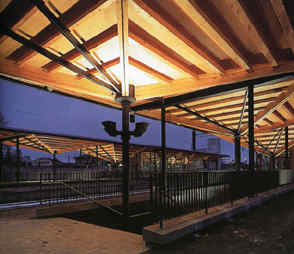 Lillestrom Station. Picture courtesy of NSB
For
the airport as a whole there was a decision early in the planning
of the main airport to use exposed matt finish on surfaces with
natural materials (stone, wood and metal). With limited environmental
materials information, both tests and analyses were done in-house,
in collaboration with the Danish-Norwegian company Hjellnes-Cowi,
As a result some products were dropped, primarily those connected
to health hazards/allergic reactions and emissions including the
release of poison in potential fire situations (through PVC and
CCA impregnated timber), as well as restrictions for using rainforest
timber. A significant part of evaluation of materials was around
issues of installation, either mechanically or chemically. Glues
and surface treatments were subject to these evaluations, which
engendered a systems approach of viewing the complex use of materials,
installation and treatment as a whole. (*see appendix 2 for criteria
of evaluation of materials.)
The
project, although centred on the airport also, included the the
design and landscaping of the new railway to Oslo. Along with
the Oslo and Gardemoen terminals, three new stations were built
on the route - Lillestrom, Eidsvoll and Asker stations. All these
buildings were subject to the environmental criteria set by the
main airport. The first two of these, Lillestrom and Eidsvoll
were designed by the veteran Norwegian transport architect Arne
Henriksen. Whilst Henriksen states that the primary consideration
was around social, aesthetic and historic issues, the environmental
project stipulation aided the design choice of natural materials
- slate and wood - for both of his stations. And he sees the environmental
provision as setting a benchmark for their integration into the
Norwegian transit building infrastructure
.
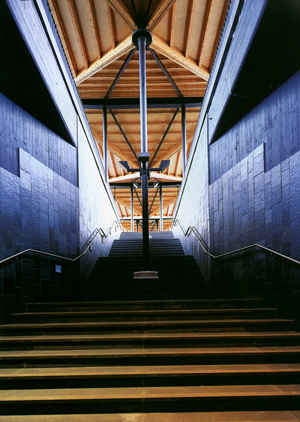 Lillestrom Station
. Picture courtesy of NSB Lillestrom Station
. Picture courtesy of NSB
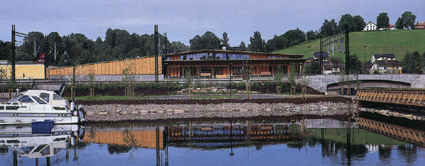
Lillestrom
is a medium-sized station in a medium-size town, on the Norwegian
scale of things. The handsome feel of the platforms and their
canopy shelters are constructed from laminated timber, glass and
steel. Beyond the entrance hallway the slate flooring underpass
links to the four platforms and the two sides of the railway-spliced
town, bringing life and a local material connection for these
separare parts of the town.
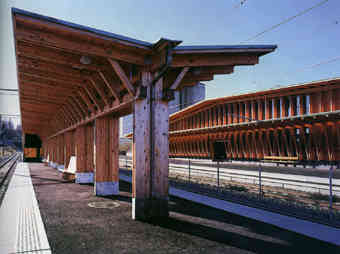
Eidsvoll
is an altogether smaller country station, at the end of the line,
beyond the airport. Once again the station canopies are constructed
from wood; a strikingly visual contrast for an English foreigner
all too used to the ubiquitous use of man-made materials in modern
British station shelter structures.
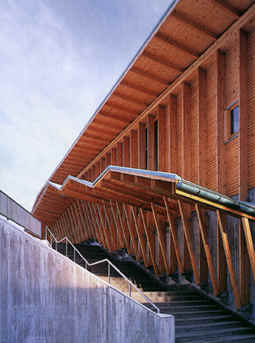 Eidsvoll Station. Picture courtesy of NSB
The
wood used in the laminated timber beams is pine grown in Norwegian
managed forests. The practice wasn't sure of the exact location,
but the region is east Norway (Østland) - the region that
encompasses Oslo. By contrast, the wood used on the walls is birch
plywood from Finland. No chemical treatment has been applied to
either the timber beams, or the plywood walls. Instead they are
treated with BioSafe oil, which contains no non-organic compounds
or other additives. Other wood, the interior floors for example,
is treated with a vegetable based soap (green soap, in effect,
in Norway).
The
slate came from the Gudbrandsdalen. region, its beauty as a building
stone has been commented on, being filled with 2-3 inch long black
amphibole crystals. This is also used at the Gardemoen airport.
The concrete is treated with multiple coats of a water-based paint
at an approximate ratio of 20% paint, and 80% water.
For
the project as a whole; both airport and railway link, the environmental
criteria were organised around the following: available natural
resources; the extent of transportation (energy consumption);
energy consumption and working environment under production; the
working environment under construction, environmental influence
during use/emissions (e.g. the in-door climate); waste and reuse
under construction and future demolishing; available environmental
declaration; recipes of ingredients for important materials; and
lifecycle analyses/lifecycle costs.
 Eidsvoll Station. Picture courtesy of NSB
Gardemoen
airport is a flagship project for Norway, and the strategic, political
and prestige reasons for including environmental issues in the
design brief ought not to be overlooked. Not only this, but the
significant limits of its environmentalism are clear as well.
Consider the ubiquitous use of glass at the airport and the newly
redesigned Oslo station site, which can hardly be claimed as an
environmental feature as far as lighting and heating is concerned,
in a country which spends so many winter hours in darkness; a
well-made and repeated point. And the point can be easily added
that airports encourage the type of unsustainable travelling that
needs to be reduced. That said, the airport, with its wave-form
and massive beam structures high above the passengers crossing
the central atrium, is an impressively striking building. As is
the whole transport system into Oslo which supplements it. As
the third largest project in Europe at the time of its building
- in the mid- nineties - the inclusion of environmental research
and design as part of its brief gives it a benchmark quality which
other transport infrastructure programmes and projects can turn
to and be compared with.
 Eidsvoll Station. Picture courtesy of NSB
A
smaller, more modest though equally interesting example of the
integration of sustainabilty with transit systems can be found
on the outskirts south-east of Stuttgart in Southern Germany.
As the result of the planning of a new local tramway (route U7),
a competition for four new stations was commisioned. The new Ruhbank
tramway, runs through the local Waldau forests, so for the proposed
station in these woods, at Degerloch, the competition stipulated
a design with local woods as a central feature. The winning result,
designed by the Stuttgart practice Jakob and Bluth, optimises
the integration of wood, glass and metal. Apart from the tramway
platform and structure on the lower level, the transit interchange
also features a bus station on the upper secondary level. The
buildings use larch for its columning and spruce for the canopies
and sheltering. Larch was used for its longevity, and in part
for its natural preservative qualities. Where the wood isn't exposed,
the larch has been left untreated. Glass is used for the roof.
Low impact boron perservative has replaced the heavily toxic copper
chrome arsenic - outlawed for the last decade in Germany. The
spruce is a glue laminated manufacture, and the technique has
produced a visually light and compelling roof, in both senses
of the word. Overall the balance between all three materials was
calculated to economically optimise the quantity of each of these
materials, so that no excess material was required. This so-called
'Minimalismus' approach is statutory in Germany and Austria, which
results both in the absence of left over cut-offs or other materials,
and as an almost co-incidental by-product, brings an aesthetic
elegance to the design. This rather than the other way round,
where the aesthetics determine the choice and use of materials.
As with many of these projects, sustainability issues found their
way into the brief, because they were architecturally relevant
rather than for particular environmental purist reasons. This,
again, is a pragmatic approach where a station has appeared which
also happens to closely fit the criteria of the sustainable building
perspective.
From these two projects emerge contrasting examples of how environmental
building practices are synergising with modern railway and transit
systems. In so doing they are forming the beginnings of new synthesis
and alliance between ecologically sensitive modes of transport
and the leading edges of building and design. The dream of railways
realising something of their promise as 'environmentally necessary
modes of transport', in Ian Jack's words, will need to reach out
to these broader environmental synergies.
appendix
1. This piece highlights projects which have utilised 'natural'
materials. There are of course many other approaches which can
be described as sustainable, depending on the definitions of sustainable
you decide to follow. Two which could be mentioned here are research
projects happening in Holland at present. First prof Adriaan Beukers,
author of 'Lightness: the inevitable renaissance of lightweight
materials' and his research team at the technical Delft University
of Technology have undertaken extensive research into ultra-lightweight
fibre-based materials with reference to transport. For details
of this part of their research see Eric Tempelman's book 'Sustainable
Transport and Advanced Materials'. For details see http://www.eburon.nl/stock_all.htm.
The
Foundation for Smart Architecture includes an interesting section
on their take on sustainable architecture and transport issues,
called unsurprisingly 'Transit'. It's at http://www.smartarch.nl/transit
but is in Dutch.
appendix
2. With regard to the Gardemoen airport project for each building
material,which was suggested by the design team, who used the
following criteria for evaluation of materials:
The
kind of use and location are the materials are meant for.
Quantity
of each material.
How
the materials are installed (mechanically or chemically).
Dimensions.
Architectonic/aesthetic
properties (surface /colour).
Functionality
Safety
Fire
protection
Acoustic
Cleaning
and maintenance
Environmental
and ecological qualities.
Lifecycle
analyses / lifecycle costs
Alternative
materials
Oliver
Lowenstein runs the green cultural journal Fourth Door Review
and the Cycle-Station Project. Material on each of these can be
found on the Fourth Door website: www.fourthdoor.co.uk.
Related pieces and projects to this piece can be found on the
recently launched Fourth Door Research new media, design and architecture
website Unstructured
in the projects section. To contact fourthdoor@pavilion.co.uk
|

