|
THE
WEALD AND DOWNLAND GRIDSHELL
The
historic scarcity of timber gridshells is understandable. They
are very complicated to engineer and to build. One problem has
been the high rate at which timber breaks this was a real problem
at Frei Otto’s Mannheim building. Another has been the lack
of wood technology adequate to produce laths long and strong enough
to create effective structures.
Image
Stuart Keegan and Elaine Duigenan
In
the intervening twenty-five years between Mannheim and the Weald
and Downland gridshell there have been parallel revolutions in
glue and wood technology which has meant the project team could
realistically contemplate laths with spans that Frei Otto could
only dream of. At Weald and Downland, research identified a Swiss
glue manufacturer, Collano's, whose recently developed polyurethane
glue; super strong, yet environmentally sound adhesive could be
used to form the long laths. This glue was used to bond six pieces
of timber together into the impressively long 35 to 50 metre laths.
At the same time French oak was sourced, chosen for quality and
cost, and cut in
France,
into much shorter, 6m laths, 35mm by 50 mm in section. Shipped
to Britain, it was next transported to specialist timber processors,
Grecon Dimter in Newcastle. There imperfections were cut out,
leaving high quality sections ranging from 30Omm to 140Omm in
length. These were finger jointed back together again to form
the 6m 'improved timber’, before being returned to Sussex
to form the extra-long laths.
As
well as this wood and glue technology the computer revolution
was a central influence on the evolution in engineering capacity,
enabling the structural engineers, Buro Happold, to test the gridshell
for weaknesses long before it was built. Buro Happold, linked
in with the structural engineering department at Bath University,
began applying off-the-shelf software modeling to explore the
bending properties and behaviour of wood, hoping to ensure minimal
breakages in the finger joints.
Image
Stuart Keegan and Elaine Duigenan
Taken
together the convergence of this computer modeling research from
the synergies between wood, glue and materials technology, is
a graphic example of how timber design is in the midst of a transformative
revolution. This convergence is enabling the potential realisation
of radically different, yet low energy, sustainable buildings,
which were hitherto too impossibly complicated to construct.
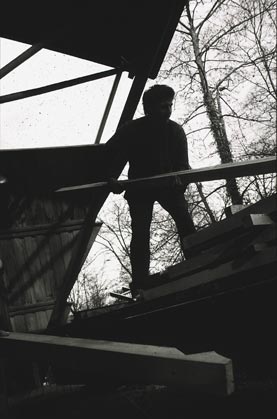
At
the same time as this modeling work was going on the project team
brought in an open-minded frame carpentry business, the locally-based
Green Oak Carpentry Company (GOCC), to carry out the physical
construction of the gridshell. The convergence of hi tech with
hands on carpentry is at the heart of how the building captured
the imagination of press and public alike. The notion of the hi-tech
new media engineers working in concert with in-the-body carpenters,
guiding them to reposition the timber to micro-exact positions,
like astronauts working on an earthbound, wooden space-station,
stirs the mind, and aptly illustrates the fusion of traditional
craft with twenty first century hi-tech. It was a gift for the
carpenters as well, enabling them to show exactly what they could
do, given half a chance. This in a building environment which
for years has been heading in precisely the opposite direction,
further and further into pre-fabrication and away from the uses
of individual skill.
Image
Stuart Keegan and Elaine Duigenan
Whereas
prefabricated inorganic materials are built to the exact gridshell
shape, wood is a living material, essentially a, albeit stiffer,
fabric. At Weald and Downland, this meant the gridshell could
be prepared on the ground flat as a two dimensional lattice grid
mat, before being moved into its vertical position, where it changed,
or deformed into a new, springy, and somewhat provisional shape.
When this happened all sorts of surprise and unexpected shapings
emerged, as the wood adjusted itself, its random living quality
making even a computer model not fully equipped to entirely anticipate
how things turn out. Indeed, knowing how the timber actually shapes
out, and doing so without it being damaged in the process, turned
out to a considerable dilemma. Previous gridshells have been pulled
or pushed up from the ground. These resulted in many of the breakages.
As a new experiment, this time the gridshell was constructed on
a specially prepared and expensive, PERI scaffolding system, standing
initially 7.5 m from the floor. The gridmat was constructed on
the raised scaffolding, resting flat, high above ground level.
Then section by section, the scaffolding was removed, and the
laths slid into its shell-like form, each piece cajoled into place
by the carpenters, a forest of jacks tightening into position
of the intricate crisscrossing laths at the connector nodes, the
elaborate whirling weave of the building's surface at last becoming
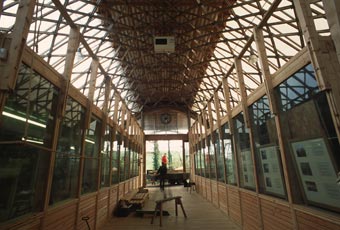
clearly visible. The diamond latticing, comprising two layers
of laths was pulled in different ways depending on their position
in the grid. The outer layer was able to slide into larger lozenges,
narrower and deeper over the domes, and flatter in the valleys.
This surface form was originally anticipated by the computer's
modeling, but once the structure was up, much fine-tuning was
needed from human eyes, supported by repeated and careful measurement.
The lower laths were tightened in relation to their upper partners.
It was here that a lot of the fine-tuning was done by eye. The
carpenters knocked the laths into position, pushed out flat areas
and deepened those where the building needed greater volume. Once
the final shape was reached, the whole building was measured again,
comparing what was in front of the team with the shape originally
modeled. Depending on your faith in the skill of the carpenters,
amazingly, or not, the gridshell closely echoed the shape of the
original digital model.
This
carpentry ethic has extended from the large-scale gridshell, right
across the building process. One example of the teamwork, involved
the original plan which envisaged positioning slotted holes at
the crossing points of the laths, but when this was taken to the
carpenters, they pointed out how difficult the hole would be to
make and the comparative cost involved. After a round of meetings,
phone conversations, emails and faxes, a new and refined design
solution emerged: the 'nodal connectors', were eventually designed,
a combined effort of everyone in the team, from the hands-on carpenters
to the engineers and architect. The result was practical in construction,
while performing several engineering functions within the finished
building and is also visually appealing.
Image
Stuart Keegan and Elaine Duigenan
In
a second example, some of the laths originally required rows of
ten bolts in close proximity to meet the Euro Code 5 timber safety
regulations, GOCC pointed out that green oak would split due to
shrinkage and was likely to split, from the number of bolts. So
again by returning to drawings, further computer modeling, and
the hands-on work of the carpenters, a solution was arrived at
which successfully transferred the load of the lath, whilst meeting
the regs and maintaining the stress integrity of the oak.
Today
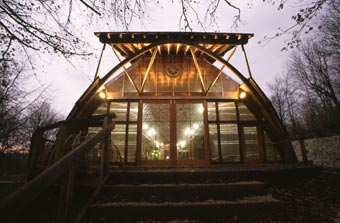
the Weald and Downland latticed gridshell is a remarkable building
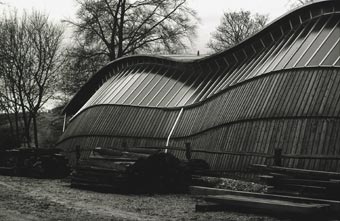
to visit. It has been covered in locally sourced Western red cedar
cladding, the roofing taking on something of a contemporary version
of the layered cladding found on Norwegian and Russian churches.
The costs are generally considered efficient, and if the environmental
costs are factored in compares particularly well to high-tech
buildings. Costing £1.6 million, the buildings planned life
of sixty years. Given all this the potential of an emergent smart
timber futurism may give the high eco-tech end of architecture
community pause for thought. Although the gridshell is very much
a showcase now, the hope is it will spur on further buildings
of its form and type.
next
|

